Beyond the Artist’s Intention

Every artist knows the strange mix of excitement and vulnerability that comes with showing work. From scoping the space, curating your work, taking lots of breaks and asking for feedback, you are preparing for an audience to see the work in all its glory. We all hope for the audience to have an aesthetic experience where the work speaks to them, inspires them, and potentially supports us. When the audience arrives, there is no telling what they are thinking. If you speak to them, they might change their answer because you’re asking them.
When creating an interactive exhibition, once the audience arrives, the artwork is no longer yours alone.

In my research and exhibitions, I discovered obvious and simultaneously surprising interactions:
Many of the audience members created games and playful symbolism.
Some objects inspired similar, almost instinctive interactions from different groups of people.
Some groups were social and turned the usually individual sensory experience into a social one by sharing stories and discoveries.
Some participants acted alone and highlighted the personal, intimate dimension of interaction.
These surprising interactions were the most meaningful part of the work.
From control to conversation
Traditional galleries often expect a passive audience: quiet, still, and respectful. However, when this control is relaxed, something new emerges. The artwork transforms into a conversation—a space where the audience's curiosity and imagination intersect with the artist's vision. Placing the installations within a gallery context might have helped encourage the audience to engage more creatively.
This doesn’t mean the artist’s intention disappears. Instead, it becomes one layer among many. My role shifted from being the content provider to being a context provider — setting the stage for experiences I could not script, predict or fully understand.
Unscripted encounters
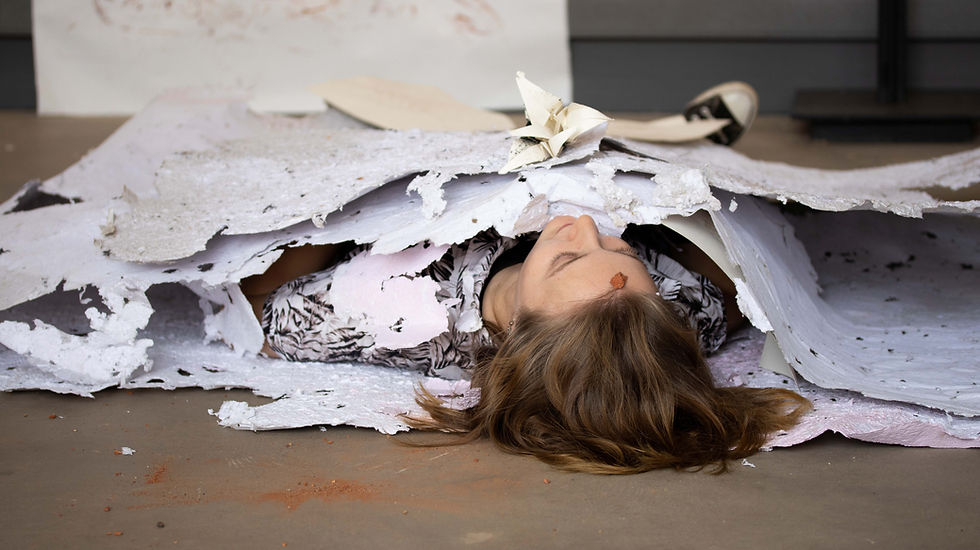
I decided early on that I did not want to prescribe the interaction to the audience and opted to keep explanations vague. This created a completely open brief where the materials and the layout inspired the interactions so that the audience and invent their paths through the installation instead of following a specific path. I decided against some of my colleagues’ advice not to add tools to make the interactions I wanted ‘more obvious’. However, in opening the possibilities up, the boundary of the exhibition was blurred, and so were the limits of what the audience couldn’t do (like break the glass windows of the space with a nearby brick). At first, my instinct was to resist. I did not want the fragile items to be destroyed, and I wanted the interactions to extend beyond writing or drawing on the objects.
Although this still happened and it wasn’t what I intended, I realised that writing, drawing and destruction were all forms of expression and the very unpredictable nature of the exhibitions that I feared was the heart of the work.
Letting go
There is a kind of freedom in letting go of total control. When audiences surprise us, they remind us that art is alive — unpredictable, relational, and always in motion.
So perhaps the challenge is not to hold on more tightly, but to embrace the unknown. Because sometimes, the most powerful moments in art are the ones we never intended.


Comments